
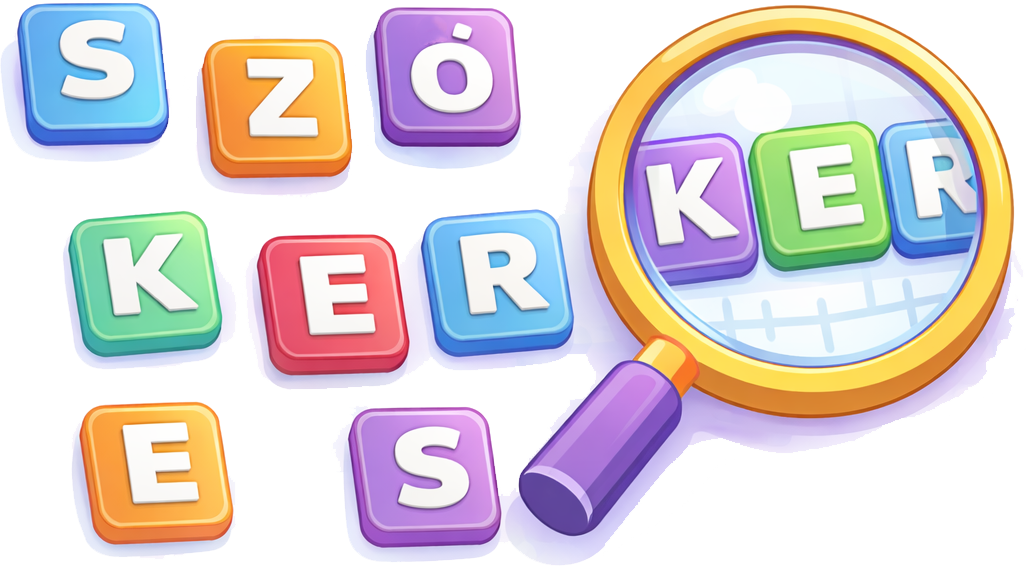




Find the hidden words in the word search
In the sea of letters, words of various topics are hidden. This digital puzzle is not only about fun, but also excels at developing visual differentiation, scanning eye movement and vocabulary while providing an exciting challenge to find hidden concepts.
The goal is simple: find the terms related to the given topic in the table! Between the letters horizontally, vertically or even diagonally the correct word forms can also be placed. An ideal choice for reading practice, concentration and conceptual thinking.
Operational logic and technical background
The game displays a letter grid in which words related to a topic are hidden. The player must “drag” the letters with the cursor or tap to select them. The software recognizes the correct direction (row, column or diagonal) and once the complete word is found, it gets a tick in the list and a colored highlight in the board. The game continues until all the listed words are found. If you want a new challenge, you can update the puzzle with the “Again” button.
- Always a fresh challenge: A new grid is generated at each start. No two puzzles are the same, so the child’s (or adult’s) brain is forced to develop a new strategy every time.
- Designed for success: The game measures time, but does not rush. The goal is to find all the words, which helps to strengthen task awareness and perseverance.
- Topic focus: Words are not random; they are grouped around a topic (e.g. fruits, animals), which helps conceptual organization.
What does the Word Search game develop?
This type of task is a cognitive abilities and it is native language skills moves a complex ensemble:
- Visual attention and scanning: The player learns to go through the characters methodically, filtering out the unimportant letters. This technique directly improves speed reading ability.
- Spatial orientation: Recognizing diagonal directions (e.g. from left to right down or from right to left up) develops plane orientation and flexible eye movement.
- Reading skills and analysis-synthesis: It helps with the global recognition of word images and the awareness of letter order, which is one of the cornerstones of reading comprehension and spelling.
- Conceptual thinking: The varied topics (e.g. nature, objects, occupations) help categorize words and organize knowledge.
- Endurance and concentration: Finding hidden words encourages patience, method and maintaining focus, especially with longer words.
- Fine motor skills and digital competence: Precise, continuous line drawing (drag-and-drop technique) develops hand-eye coordination and the conscious use of the touch screen.
Tips for effective development
- Methodology: It’s worth looking for the longest words first, because they take up the most space in the grid.
- Search strategy: Try to find the first letter of the word on the board, then look around the 8 directions for the second letter!
- Replay: The “Repeat” button doesn’t just return the same track: the engine then reshuffles the words and letters, so a fresh, unfamiliar grid awaits each time.
Game guide and FAQ
How does the word search game work?
You have to find words hidden in the letter grid horizontally, vertically or diagonally and then select them.
What is the purpose of the word search game?
The word search offers both language repetition and a visual search task.
What does the word search game develop in children?
It develops letter recognition, spelling, vocabulary, skim reading and attention.
What tips help you during the word search game?
Choose a rarer letter of a search word and search for it first in the grid. From there, explore all possible directions.
How hard is the word search game and what should you know about it?
Shorter words and smaller grids are easier; words placed backwards or diagonally increase the challenge.