





Snap the ball and break the wall!
The eternal classic of arcade rooms in a new guise: a wall breaking game provides hours of challenge with just one ball and one racket. The rule is simple at first glance, but a good result requires precise timing, constant attention and a little foresight. That is why it is an excellent exercise for developing hand-eye coordination and reaction time.
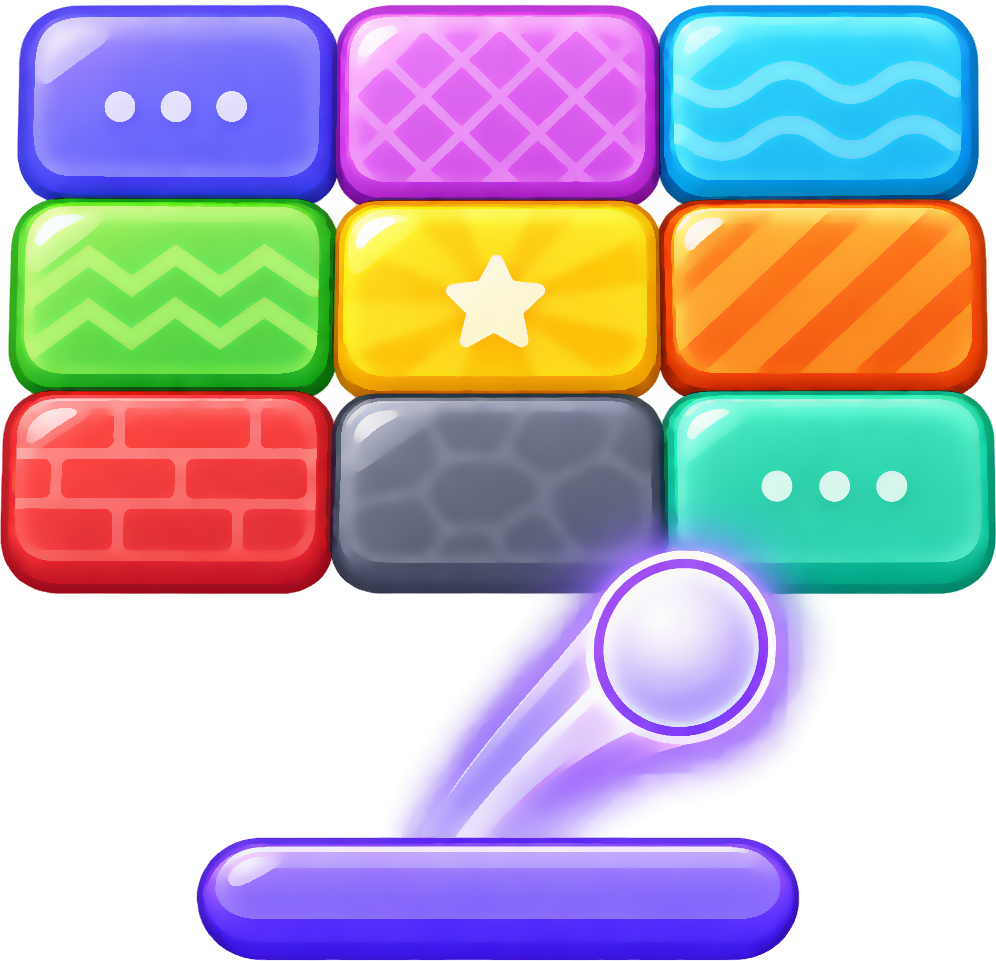
The goal is to pop the ball with a movable bat at the bottom of the screen and knock down the colored blocks lined up one by one. If the ball rolls past the racket, you lose a life. The course is completed when you have removed all the breakable blocks. Thirty-six courses are waiting for you: on the first ones, you can still familiarize yourself with the ball’s behavior, but on the later ones, faster balls, narrower rackets and harder blocks make your job more difficult.
Operational logic and technical background
The racket can be moved with the mouse, finger and the arrow keys, you can launch the ball by clicking or using the spacebar. The direction of the rebound depends on which part of the racket the ball hits: from the center it starts sharply upwards, from the edge sharply to the side. This detail makes the wall breaking game really controllable – where the ball goes doesn’t depend on luck, it depends on you.
- Several types of blocks: traditional blocks break on one hit, reinforced blocks on two or three hits, and indestructible ones stay on the court and deflect the ball.
- Bonuses and Perils: the capsules that fall from the bonus blocks must be caught with the racket, while the dangerous blocks accelerate the ball – think carefully when you hit them.
- Net scoring: the score is made up of knocked down blocks, remaining lives and the speed of the ride, so the same track can be completed with multiple strategies.
Unnoticeable geometry: the path of the ball teaches angles
The most beautiful learning benefit of the wall breaker works almost imperceptibly. In order to have the racket in place in time, the player must constantly estimate, where does the ball go next? – and this is pure geometry. The ball bounces off the wall at the same angle as it arrived, and the racket decides whether to hit the center or the edge. The child does not work with a protractor, but with his eyes: after a few rounds, he can sense at which point on the court a ball arriving at a certain angle will land.
The characteristics of the track make this estimate really exciting. An indestructible block, a narrow passage, or a slanted row of blocks all deflect the ball, so each course creates a different bounce pattern. So it is not enough to watch the ball: you have to think ahead about where its journey will continue after the next collision. This kind of projection—running the direction of the bounce in your head—is the same skill you’ll learn later in geometry class as mirroring and angle recognition.
What does the wall-breaking game develop?
Behind the simple gameplay is the combined mobilization of several skills:
- Hand-eye coordination: the continuous, fine adjustment of the racket to the movement of the ball directly develops fine motor skills and the accuracy of the movements.
- Reaction time and sustained attention: you have to keep an eye on the ball all the time, while also paying attention to the falling capsules – this strengthens the division of attention.
- Foresight and planning: a good player does not go where the ball is, but where it will arrive. This exercises the estimation of trajectory curves and the inference.
- Angle detection and spatial estimation: predicting the direction of the rebound subtly practices angle recognition and the concept of reflection—long before those words come up in math class.
- Endurance and failure tolerance: starting over after losing lives is a natural part of the game, which helps you treat mistakes as lessons.
Tips for effective development
- The edge of the racket is your steering wheel: if you want to send the ball to the side, consciously meet it with the edge of the club, not the middle.
- Make your way up: it is worth breaking a passage on one side so that the ball goes over the blocks and breaks them in a row from there.
- Wait in the middle: return to the center of the court between two shots, so you have time to react to both sides.
- Time the acceleration: knock out the dangerous blocks when there are few blocks left and the remaining course is short.
Game guide and FAQ
How does the wall breaker game work?
At the bottom of the screen, you have to bounce the ball back with a movable racket to knock down the blocks that are lined up one by one.
What is the purpose of the wall breaker game?
All breakable blocks must be removed so that the ball does not roll past the racket.
What does the wall-breaking game develop in children?
Eye-hand coordination, reaction time, sustained attention and predicting the trajectory of the ball.
What tips help you during the wall breaker game?
Control the ball with the edge of the racket, clear a path over the blocks and return to the center of the court between two hits.
How many levels are there and how difficult is the wall breaker game?
There are thirty-six courses. The first twelve are free to play, the rest are premium. As you progress, the ball speeds up, the racket narrows, and reinforced, bonus, and dangerous blocks appear.
Does the wall-breaking game develop mathematical thinking?
Yes. To predict the bounce of the ball, the angles and the direction of the reflection must be estimated in your head, based on the layout of the court. In this way, the game unnoticeably practices the geometric approach.