






Find the perfect place for the Tetris shapes!
In the sea of falling colorful items, your spatial vision and your ability to make quick decisions are the keys. This digital classic is not only about entertainment, but also excellently develops the visual design, a hand-eye coordination and the logical thinking, while providing an exciting challenge by continuously eliminating lines.
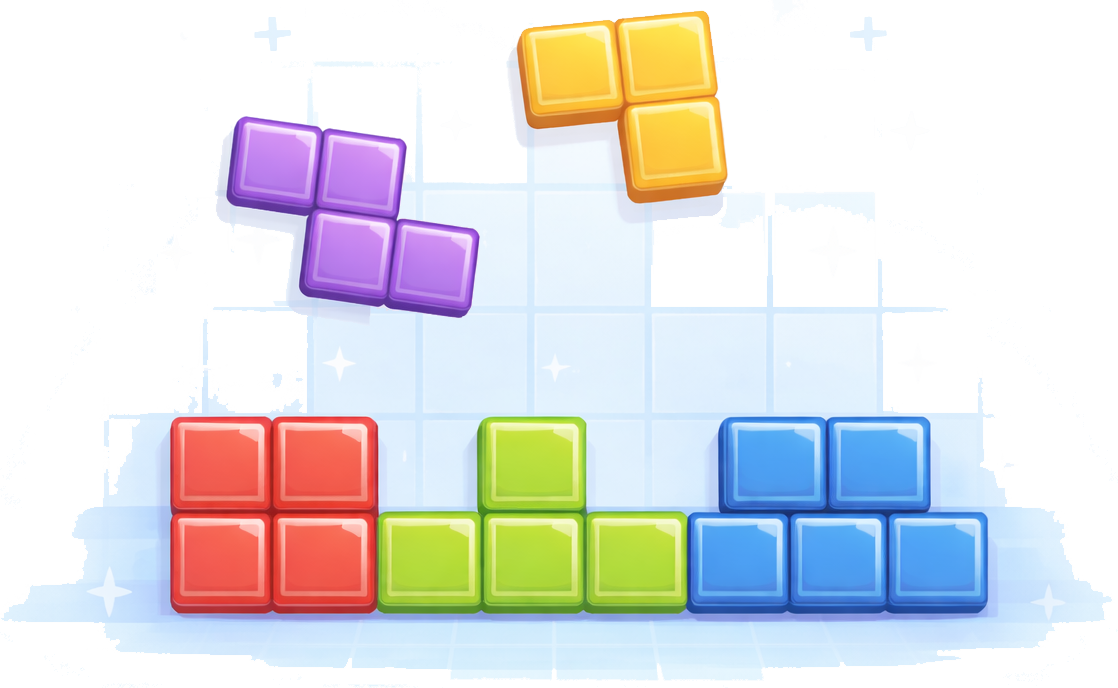
The goal is simple: rotate and fit the tumbling shapes so that they form complete rows horizontally! As soon as a row is full, it disappears, giving way to new elements. An ideal choice for concentrating attention, improving reaction time and practicing strategic planning.
Operational logic and technical background
The game generates various geometric shapes (tetrominos) that descend from top to bottom on the track. The player has to use the arrows or touch to rotate and move the elements laterally to match them exactly. The software monitors the closed rows: as soon as all cubes are placed in a row, that part is destroyed and points are awarded. The game continues until the shapes reach the top of the playing field. If you want to set a new record, you can start with a clean slate at any time with the “Reset” button.
- Always a fresh challenge: The order of arrival of the shapes is random. No two runs are the same, so your brain has to adapt to a new layout each time.
- Designed for success: The game measures the score achieved and the time spent. The goal is to achieve the highest possible score, which helps to strengthen task awareness and internal motivation.
- Logical centrality: Elements do not fall randomly; to play successfully, you need to anticipate the next shape, which helps with strategic organization.
What does Tetris game develop?
This type of task is a cognitive abilities and it is dexterity skills moves a complex ensemble:
- Visual attention and planning: The player learns to systematically see through the available spaces, filtering out bad matching possibilities. This technique directly develops problem-solving skills.
- Spatial orientation: Rotating the shapes and inserting them into the correct slot develops plane orientation and mental rotation (rotating shapes in the head).
- Reaction time and decision making: It helps with quick situation recognition and calm decision-making under pressure, which is one of the cornerstones of controlling attention.
- Concentration and endurance: The constant congestion of lines encourages patience, methodicality and maintaining focus, especially with the accelerating pace.
- Fine motor skills and digital competence: Precise control and quick placement of shapes develop hand-eye coordination and the conscious use of tools.
Tips for effective development
- Methodology: It is worth striving for a smooth surface, do not leave high protruding “towers”, because they block the place of the following elements.
- Search strategy: Watch for the next arriving shape on the edge of the display and plan its location before it arrives!
- Replay: With the “Again” button, a fresh, unknown sequence awaits you every time, so you can constantly improve your own record.
Why should you choose this?
- 100% Ad-free: No annoying pop-ups or hidden ads.
- Safe content: No violent or inappropriate content.
- Hungarian development: The work of domestic specialists, Hungarian-language interface.
- Child-friendly design: Simple and friendly interface, no overclocking.
- Without installation: You just open the browser and the game is ready to start – on any device.
- Regular updates: New features and content so there’s always something to explore.
Game guide and FAQ
How does Tetris work?
The shapes coming down must be moved and rotated to make horizontal rows without gaps. The entire row disappears and frees up space.
What is the purpose of Tetris?
The constantly changing situation calls for quick, yet well-planned decisions.
What does Tetris develop in children?
It trains spatial thinking, mental rotation, reaction, planning ahead and attention.
What tips help you with Tetris?
Keep the surface evenly low and leave room for the long element. Look at the next shape as well, not just the current one.
How hard is Tetris and what should you know about it?
Tetris was created by Alexey Pazitnov in 1984. The accelerating pace gradually increases the difficulty.