









Tangram – A playful shape inserter to develop visual logic
Tangram is a genius with a centuries-old history form inserter game that develops children’s logical and spatial thinking imperceptibly. It’s not just a simple puzzle: while pushing and connecting the colorful geometric shapes, the little ones learn to break down the world they see into its elements, while developing their problem-solving skills and creativity.
This game is the perfect tool to build your visual intelligence. It was specially designed so that children can play it out of intrinsic motivation, for the joy of discovery. It does not urge, it does not punish – instead it gives a sense of success, while fine-tuning the recognition of part-whole relationships and confident spatial orientation.
Operational logic
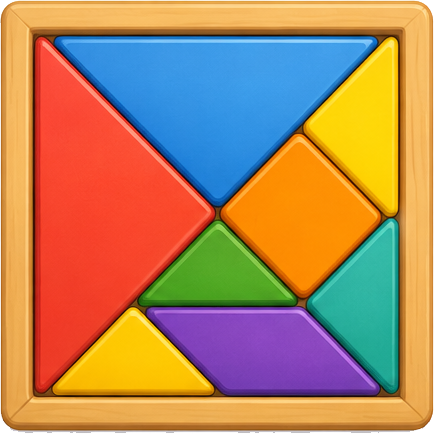
The goal of the game is for the player to build different shapes – animals, objects or human figures – from seven basic geometric shapes (triangles, squares and parallelograms). The clean, uncluttered visual world ensures that nothing distracts the child’s attention from the essence: the relationship of shapes to each other.
During the mission, children must recognize how different sized elements complement each other and how to rotate them to fit perfectly. The system gives immediate, positive feedback when an element is placed in place, so the feeling of success is guaranteed. As soon as the picture is assembled, the level is closed and the opportunity opens for new, exciting challenges.
What does Tangram develop?
The classic form inserter mechanics supports several key areas of child development:
- Spatial vision and visual-spatial intelligence: Rotating, mirroring and positioning the shapes helps the child to mentally map the space, which is a solid foundation for later mathematical and geometrical studies.
- Problem-solving thinking: The game encourages the child to experiment. If an element doesn’t fit, you have to find a new strategy that develops flexible thinking and logic.
- Recognizing a part-whole relationship: It teaches children to visually break down complex shapes (e.g. a dog or a house) into simpler geometric elements.
- Creativity and abstract thinking: Although the rules are fixed, the endless combination of shapes sparks the imagination, showing how some simple shapes can become living forms.
- Concentration and endurance (monotony tolerance): Tangram requires close attention. Correcting fine details teaches patience and increases task awareness.
Is the game free?
Yes, the Tangram its interactive version is available completely free of charge on the SmartKiddos interface. The game was designed to provide an ad-free, safe and ad-free environment where children can develop undisturbed and at their own pace.
Game guide and FAQ
How does the Tangram game work?
Geometric elements must be rotated and positioned to exactly fill the specified outline, without overlap or gaps.
What is the purpose of the Tangram game?
Tangram offers multiple ways of thinking for a single target shape, so it supports experimentation well.
What does the Tangram game develop in children?
It develops spatial orientation, mental rotation, shape recognition and the understanding of the part-whole relationship.
What tips help you while playing Tangram?
Start with the largest elements and the characteristic corners, then fill in the remaining area with the smaller pieces.
How hard is the Tangram game and what should you know about it?
Tangram is a puzzle of Chinese origin, traditionally consisting of seven geometric elements. More complicated silhouettes require more advance planning.